
The dream of the digital nomad life is more accessible than ever for the modern college student. With a laptop and a stable Wi-Fi connection, your classroom can be a beachside café in Bali, a library in Prague, or a bustling workspace in Tokyo. However, this freedom comes with a significant invisible weight: the responsibility of securing your digital footprint. When you are constantly hopping between public networks and crossing international borders, your personal data—and your academic work—becomes a prime target for cyber threats. Transitioning from a traditional campus to a global office requires a complete shift in how you perceive digital safety.
Staying productive while traveling means you often have to juggle tight deadlines and unstable connections simultaneously. Many students find that managing heavy workloads while navigating new time zones is the hardest part of the journey. If you find yourself overwhelmed by complex technical coursework, seeking professional computer assignment help through the dedicated experts at myassignmenthelp ensures your projects remain on track without compromising your security or academic standards. By offloading the stress of intricate coding or database tasks to a secure, verified environment, you can focus on the logistics of your travels and the safety of your hardware.
The Landscape of Digital Threats in 2026
As we move deeper into 2026, the methods used by cybercriminals have evolved. It is no longer just about basic viruses; it is about sophisticated social engineering and automated “sniffing” bots that patrol public access points. For a student, the stakes are uniquely high. You aren’t just protecting a bank account; you are protecting years of research, intellectual property, and your standing with your university. One compromised password could lead to a locked student portal, potentially causing you to miss registration or lose access to critical financial aid documents.
The Anatomy of Public Wi-Fi Risks
Public Wi-Fi is the lifeblood of the digital nomad, yet it is also the most common entry point for hackers. Most “Free Wi-Fi” spots in airports or hostels are unencrypted. This means that a malicious actor sitting in the same room can use “sniffing” software to intercept everything you do online, from typing in your social media passwords to accessing your university’s student portal.
Man-in-the-middle (MITM) attacks are particularly dangerous because the hacker positions themselves between your device and the connection point. They essentially act as an invisible relay, silently stealing data as it passes through. To combat this, a high-quality Virtual Private Network (VPN) is non-negotiable. A VPN creates a secure “tunnel” for your data, encrypting it so that even if a hacker intercepts the signal, it remains unreadable. Furthermore, you should always check your device settings to ensure that “File Sharing” and “AirDrop” are turned off when you are in public spaces. These features are convenient at home but serve as open doors for strangers to drop malware onto your hard drive in a crowded café.
Securing Your Physical and Digital Hardware
Cybersecurity isn’t just about software; it is about the physical protection of your tools. A lost or stolen laptop isn’t just a financial hit—it is a total breach of your identity. Modern nomads should use full-disk encryption, such as FileVault for Mac or BitLocker for Windows. This ensures that even if someone physically steals your device, they cannot access your files without your master password. Additionally, using privacy screens—thin filters that limit the viewing angle of your monitor—prevents “shoulder surfing” in tight seating arrangements like airplanes or trains.
The complexity of modern curricula means students often carry massive amounts of sensitive data related to their majors. For those tackling advanced technical degrees, the pressure to maintain both security and high grades can be immense. If you are struggling to keep up with rigorous coursework while on the move, getting help with engineering assignments is a practical way to ensure your complex calculations and design projects are handled with precision while you focus on fortifying your digital defenses.
Comparing Security Measures: A Student Guide
| Security Layer | Primary Tool | Function | Essential for Students? |
| Network Security | VPN (Virtual Private Network) | Encrypts internet traffic on public Wi-Fi. | Critical |
| Identity Protection | MFA (Multi-Factor Authentication) | Adds a second verification step for logins. | Critical |
| Physical Security | Privacy Screen & Disk Encryption | Prevents visual and physical data theft. | Highly Recommended |
| Data Integrity | Zero-Knowledge Cloud Storage | Securely backs up assignments and research. | Highly Recommended |
| Account Safety | Password Manager | Generates and stores complex, unique passwords. | Recommended |
Implementing Multi-Factor Authentication (MFA)
If there is one single step that can prevent 99% of common account takeovers, it is Multi-Factor Authentication. Password leaks are common, especially if you accidentally use the same password for a travel booking site and your university email. MFA adds a second layer of defense—usually a code sent to your phone or an authentication app. Even if a cybercriminal guesses your password, they cannot enter your account without that second, time-sensitive code.
For digital nomad students, it is better to use an “Authenticator App” (like Google or Microsoft Authenticator) rather than SMS-based codes. Why? Because when you travel, you might swap SIM cards or lose cellular service. Authenticator apps work offline and are much harder for hackers to intercept compared to text messages, which can be rerouted through “SIM swapping” scams.
Data Residency and International Privacy Laws
When you cross borders, the laws governing your data can change. Some countries have strict surveillance laws, while others have very loose protections for consumer privacy. As a student, your university likely has specific rules about where and how academic data can be stored. If you are handling research data that is protected by privacy acts, you must be careful about using local cloud storage or public computers in “high-risk” regions.
Always use a “Zero-Knowledge” cloud storage provider. These services encrypt your files before they even leave your computer, meaning even the company hosting the data cannot see what is inside your folders. This is the gold standard for protecting your thesis, your research, and your personal identity documents while moving through different legal jurisdictions.
The Importance of Software Hygiene
We all get those “Update Available” notifications at the worst possible times, but for a nomad, clicking “Install Now” is a vital security habit. Most software updates are not about new features; they are “patches” for security vulnerabilities that hackers have recently discovered. If you are running an outdated version of Chrome or Zoom, you are essentially leaving a window unlatched in your digital house.
Before you start a new semester abroad, do a “Digital Spring Cleaning.” Remove any apps you don’t use, clear your browser cookies, and update your operating system to the latest version. The less “bloat” you have on your device, the smaller your attack surface becomes. This simple routine significantly reduces the chances of a random malware infection ruining your semester.
Managing Financial Security on the Road
Banking while traveling requires its own set of rules. Avoid logging into your primary bank account while on public Wi-Fi, even with a VPN, unless it is an emergency. Instead, use “Neobanks” or travel-specific cards that allow you to freeze and unfreeze your account instantly from a mobile app. Set up real-time transaction alerts so you are notified the second a purchase is made. If you see a charge you don’t recognize, you can stop the thief before they drain your entire tuition fund.
It is also wise to keep a “Digital Emergency Kit.” This is an encrypted folder (or a physical, encrypted USB drive) containing scans of your passport, your visa, your university ID, and your insurance papers. Having these accessible in a secure cloud environment means that if your physical bag is stolen, you aren’t left stranded in a foreign country without a way to prove who you are.
Social Engineering: The Human Weakness
The most sophisticated encryption in the world cannot save you if you fall for a “Phishing” scam. Hackers often target students with emails that look like they are from the university registrar or a scholarship board, asking you to “log in to verify your enrollment.” These are often timed to coincide with the start of a semester when students are most distracted.
Always check the actual email address of the sender, not just the display name. If you receive a suspicious request for information, go directly to the official website by typing the URL into your browser rather than clicking a link in an email. Being skeptical is your best defense against social engineering.
Backup Strategies: The 3-2-1 Rule
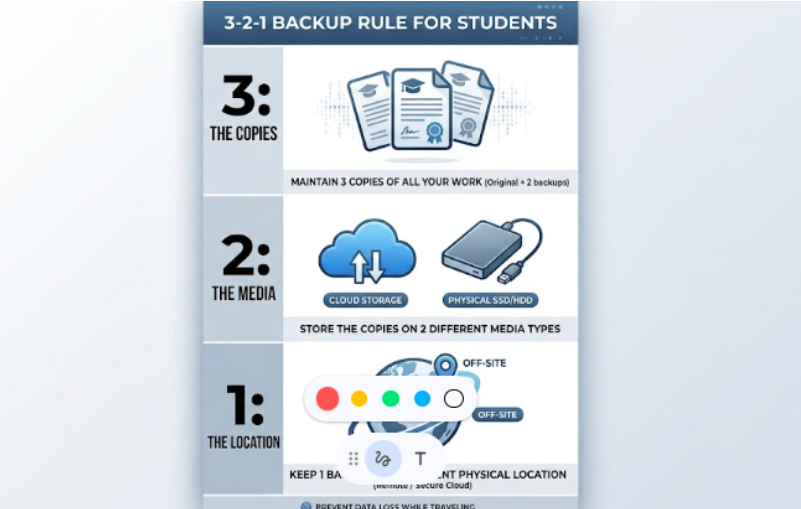
A common mistake for student nomads is relying on a single backup method. If your laptop and your external hard drive are both in the same backpack that gets stolen, your data is gone forever.
Follow the 3-2-1 backup rule:
- 3 copies of your data (Original + 2 backups).
- 2 different media types (e.g., Cloud + Physical SSD).
- 1 backup kept off-site (In a different physical location or a different cloud provider).
Conclusion: Freedom Through Preparation
Being a digital nomad student is an incredible privilege that offers a global perspective no classroom can match. But this lifestyle demands a professional approach to technology. By treating your cybersecurity with the same discipline you apply to your studies, you protect your future, your finances, and your peace of mind.
Invest in a solid VPN, embrace multi-factor authentication, and stay updated on the latest security trends. When your digital house is in order, the world truly becomes your campus. You can sit in that café, sip your coffee, and focus on your goals, knowing that your data is locked down and your academic journey is moving forward securely. The key to successful nomadic life isn’t just where you go, but how safely you travel through the digital landscape. With the right tools and habits, you can master the art of the global student lifestyle without ever becoming a victim of the digital frontier.
Frequently Asked Questions
How can I stay safe on public Wi-Fi?
Always use an encrypted connection via a virtual network and disable automated file-sharing features. This prevents unauthorized users on the same network from intercepting your traffic or accessing your hardware.
What is the best way to secure my accounts?
Enable multi-factor authentication using an app-based code rather than text messages. This adds a vital second layer of protection that remains functional even if you change phone numbers while traveling abroad.
How do I protect my files from physical theft?
Ensure your internal drive is fully encrypted with a master password and use a physical privacy filter on your screen. These measures ensure that even if your device is stolen, your personal information remains unreadable.
What should I do if I lose my primary device?
Maintain an off-site digital backup of your essential identity documents and academic work in a secure cloud environment. Having remote access to these files allows you to maintain your progress and verify your identity from any new location.
About The Author
Min Seow is a lead digital strategist and educational consultant at MyAssignmentHelp. With a focus on academic innovation, she develops comprehensive resources that empower students to navigate the complexities of modern higher education.